You had good eyes. You read the bottom line without thinking about it. Nobody in your family needed glasses at twenty-eight, and neither did you.
Then the room went a little soft. You squinted at a street sign and figured you were tired. Six months later you were at an eye exam, and someone handed you a card with a number on it. And every year since, that number has gone up.
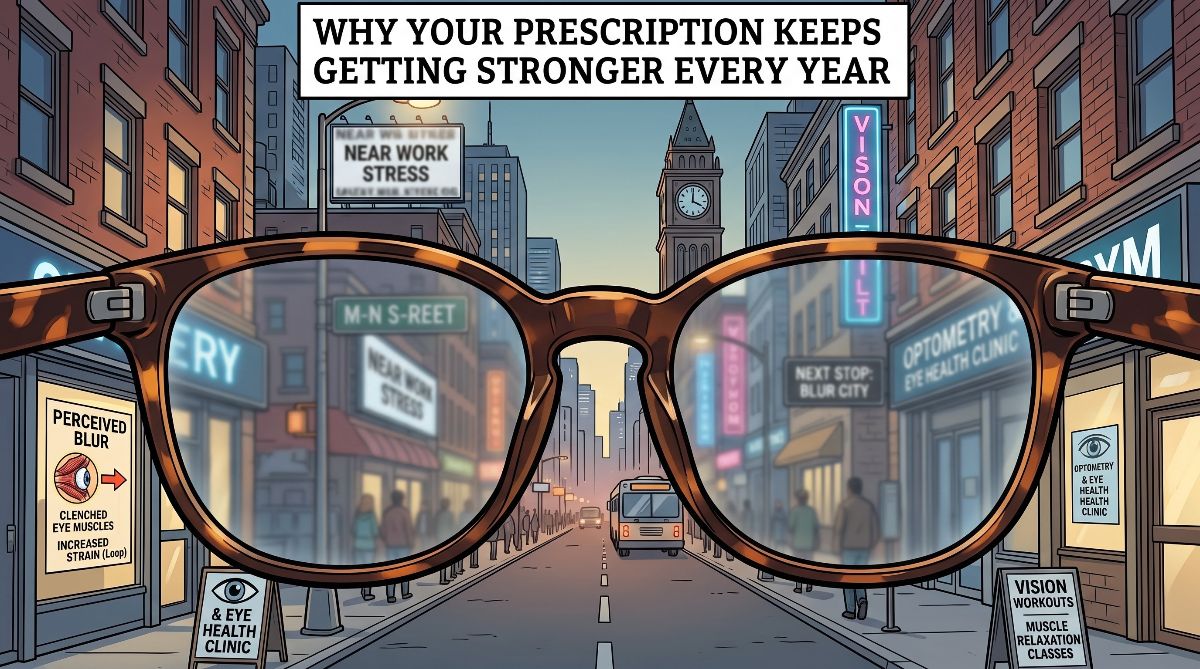
That is not bad luck. That is a loop. And once you see how it runs, you cannot unsee it.
Step one: the muscle stays half-clenched
Your eye has a small muscle that pulls focus close. It contracts when you read, contracts when you're on your laptop, contracts when you check your phone. Hours of that, every day, no breaks.
Then you look up, and the far wall is soft. It clears eventually, so you shrug it off.
It is not nothing. Wagner and his colleagues [1] put people through half an hour of reading at close range and measured what came out the other side. The nearsighted subjects came away with a real, measurable shift toward blur that outlasted the task. The muscle had not fully let go.
Step two: the world you work in makes it worse
Dim rooms. Flat, gray screens. Low contrast everywhere.
When your eyes cannot find a sharp edge to lock onto, they drift toward a lazy resting point. And here is the part that should stop you cold: that resting point is not neutral. Leibowitz and Owens [2] mapped it decades ago and placed it near one and a half diopters of myopia. Your eyes, given nothing to hold, settle into blur on their own.
Now stack that on top of a muscle that is already half-clenched, eight hours a day, five days a week.
Step three: your brain gives in
This is where it turns from a bad day into a condition.
Your brain does not have a fixed idea of what "sharp" looks like. It calibrates to whatever you show it. Webster and his team [3] demonstrated this cleanly in 2002: live in soft images long enough, and the brain quietly resets its baseline. Blurry becomes the new normal. A genuinely sharp image starts to look wrong. Too sharp. Unnatural.
Read that again. Your brain stops flagging the blur as a problem.
And the moment it stops flagging the blur, it stops asking your eyes to fix it. You are no longer fighting. You have been recruited.
Step four: the exam that cannot tell the difference
So you go get checked. Dim room, chin on the rest, lenses clicking in front of your face. Better, or worse? Better. Or worse?
Here is what that exam cannot see. A muscle that is half-clenched and an eye that has genuinely changed shape produce the same number on the card. Identical. There is no way to tell them apart without a specific test, and that test is not the one you just had.
You walk out with a prescription. Nobody lied to you. Nobody was careless. The number is real. But nobody ever told you what it was made of.
Step five: the lens deletes the signal
Glasses on. The world snaps into focus. Relief.
And something quiet happens that nobody mentions.
The blur was a message. It was your eye's way of saying: let go. That message is the only reason the muscle would ever release. It is the error signal, and it is the entire feedback loop.
Put a lens in front of it, and the message disappears. Not resolved. Deleted. The muscle is never asked to let go again, because from the inside, everything looks fine.
The strain does not go away. It gets furnished. It moves in.
Step six: it runs again
Nothing about your life changed. Same laptop, same phone, same dim room, same nine hours. The muscle stays half-clenched. The brain keeps calling it normal.
Next year, same chair, same clicking lenses. The exam reads the strain that was already there, plus whatever piled on since. Stronger lens.
And you go home believing your eyes got worse.
Maybe they did. But the number climbing does not prove your eye grew. It proves nobody ever removed the strain.
Now the unfiltered truth
I could stop here and let you think this is all muscle. It would sell better. It would not be true.
Blur is not only uncomfortable. It is a growth signal. Smith and Hung [4] degraded the retinal image in young primates and watched their eyes grow longer, and the more they blurred the image, the more the eye grew. That is one of the most repeated findings in vision science, and it is not in dispute.
That machinery quiets down once you are grown. It does not switch off. The International Myopia Institute [5] reports that adults who become nearsighted keep drifting, roughly a diopter between twenty and thirty, and that drift involves real change to the eye itself.
So no, one year of glasses is not going to stretch your eyeball. That is not the claim, and anyone who tells you otherwise is selling something.
The claim is this: you are sitting in a blurred world with the signal switched off, for a decade, standing on a trigger and betting it does not fire.
Some people lose that bet. It is a risk, not a fate. But it is a risk that gets more expensive every year you leave it alone.
How much can
your vision improve?
Book free evaluation
91.6% of clients read at least one more line on the chart by the end of this call.
What actually runs the loop
Go back and look at it. Every step turns on one thing.
The muscle stays half-clenched because nothing asks it to let go. The brain settles for less because nothing tells it to reach. The exam misses it because nothing separates the muscle from the shape of your eye. The lens closes the circle because it deletes the only message that could break it.
The loop does not run on your eyes getting weaker. It runs on a signal nobody restored.
Put that signal back, and the loop runs the other way.
So how much of your number is the loop?
That is the only question that matters, and nobody has ever answered it for you.
Part of your prescription is the shape of your eye. That part stays. The rest is a muscle that never let go and a brain that stopped reaching. That part can be trained. Two people can walk out of the same exam with the same card, and one of them has almost nothing to work with, whilst the other has been sitting on years of recoverable vision without knowing it.
You will not find out by reading. You find out by testing.
That is what the evaluation is for. We put your eyes through the work and we watch what happens. If you read further down the chart before the session ends, that line did not come from your cornea and it did not come from the length of your eye. It came from the part that was trainable all along. Your loop is running, and it can be run backwards.
And if nothing moves, you will know that too. Honestly, and for the first time.
I cannot tell you where your ceiling is. What I can tell you is that almost nobody has met theirs.
Book your free evaluation and find out which one you are.
How much can
your vision improve?
Book free evaluation
91.6% of clients read at least one more line on the chart by the end of this call.
- Wagner, S., Schaeffel, F., Zrenner, E., & Strasser, T. (2019). Prolonged nearwork affects the ciliary muscle morphology. Experimental Eye Research, 186, 107741. https://www.sciencedirect.com/science/article/pii/S0014483519300818 ↩
- Leibowitz, H. W., & Owens, D. A. (1975). Anomalous myopias and the intermediate dark focus of accommodation. Science, 189(4203), 646–648. https://www.science.org/doi/10.1126/science.1162349 ↩
- Webster, M. A., Georgeson, M. A., & Webster, S. M. (2002). Neural adjustments to image blur. Nature Neuroscience, 5(9), 839–840. https://www.nature.com/articles/nn906 ↩
- Smith, E. L., III, & Hung, L. F. (2000). Form-deprivation myopia in monkeys is a graded phenomenon. Vision Research, 40(4), 371–381. https://www.sciencedirect.com/science/article/pii/S0042698999001844 ↩
- Bullimore, M. A., Lee, S. S., Schmid, K. L., et al. (2023). IMI — Onset and progression of myopia in young adults. Investigative Ophthalmology & Visual Science, 64(6), 2. https://myopiainstitute.org/imi-whitepaper/imi-onset-and-progression-of-myopia-in-young-adults/ ↩