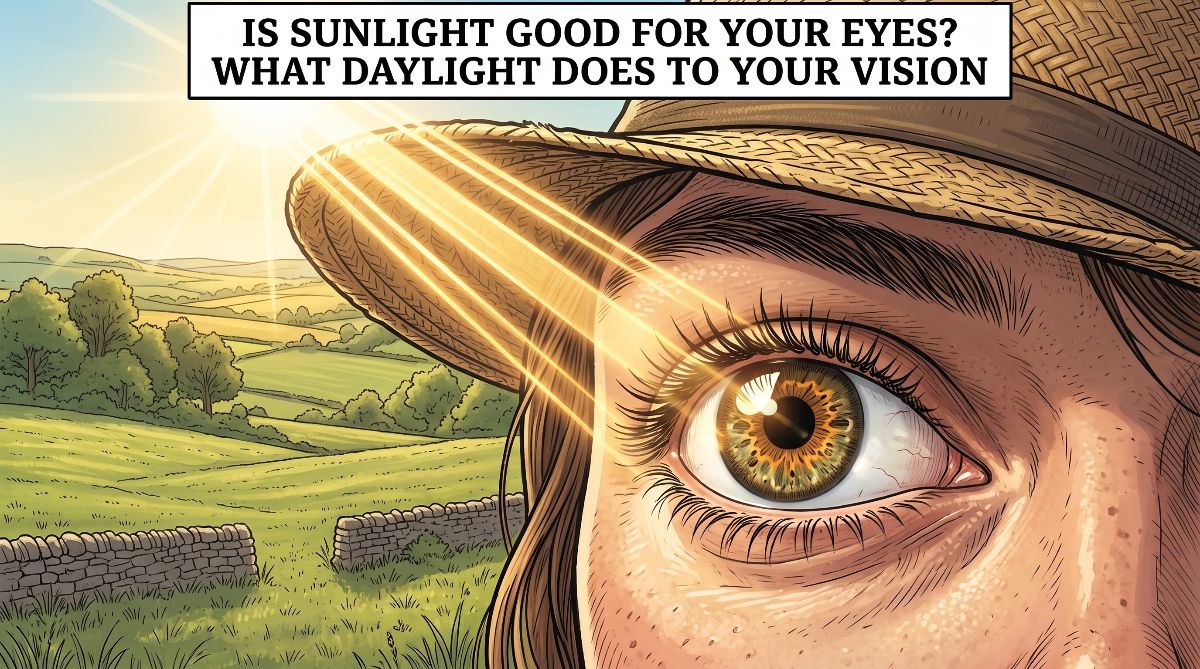
You think your office is bright. Your eyes disagree. Step outside on a gray, cloudy day. No sun, just clouds. You just walked into light ten to forty times stronger than the room you left. On a clear day, direct sun runs two hundred times stronger than your desk.
Norton and his colleagues [1] laid out these numbers plainly: indoor light sits at a few hundred lux, whilst the outdoors runs into the tens and hundreds of thousands. Your eyes were built out there, in that ocean of light. They spend your whole adult life in a puddle.
What daylight does to your vision
When bright light lands on your retina, it releases dopamine. And retinal dopamine is one of the main brakes on the eye growing too long, which is the exact change that becomes nearsightedness.
Ashby and his colleagues [2] showed it clean. Raise the light, the drift toward myopia slows down. Block the dopamine signal, the protection vanishes. That is proof the light was working through that one pathway. More light, more brake. Less light, the brake comes off.
You are sitting under the loosened brake right now.
Does sunlight improve eyesight and sharpen focus?
Here is the part almost nobody understands, and it is essential to know.
In bright light, your pupil shrinks to its smallest. And a small pupil works like a pinhole. It throws out the scattered, unfocused rays coming in at the edges. It deepens your range of focus. It sharpens the image landing on the back of your eye.
But it does one more thing, and you can feel this one. A smaller pupil takes the load off your focusing muscle. As the clinical literature on pupil size [3] spells out, a small aperture increases depth of focus and lowers the accommodative demand, so the muscle does not have to grind to hold things clear.
Bright light. Small pupil. Sharp image. Muscle at rest. That is your eye running at factory settings. When a full day of screens has your system glitching and your focus swimming, stepping into real daylight is the closest thing you have to a hard reset.
Why morning sunlight helps your eyes
There is a reason the first hour outside feels different.
Here is what is not covered by science yet. But I experience it in my personal studies and in my clients. That first daily hit of distance and daylight tunes the whole visual system for the hours after it. The proven part is narrower. Morning light anchors your body clock, distance rests the muscle. That morning hour quietly sets your focus for everything that follows.
Does vitamin D affect your eyesight?
Yes, sunlight builds vitamin D. And this is where most people either oversell it or wave it off, and both are wrong.
A shortage of vitamin D does not reach up and blur your vision on its own. What it does is quieter, and worse. It is a sign the whole supply chain has gone thin. It helps set up an environment where the eye defends itself poorly, where nearsightedness and a lot of other trouble besides get an easier time taking hold.
Vitamin D is not a pill that fixes eyes. It is one link in a chain that real sunlight sets off through your whole body. And when that link runs low, it is usually because the whole chain went quiet. Light, movement, time outdoors, all of it. Mendelian randomization work [4] tells us the proven part is narrow, that vitamin D tracks your outdoor exposure more than it directly drives the eye. What I believe is coming is bigger. That it does far more inside that chain than the current studies have pinned down.
Does exercise improve your eyesight? How to feed your eyes
The back of your eye eats through a single pipe.
The choroid is a dense bed of blood vessels behind the retina, and it is the only supply line to your photoreceptors, the cells that actually catch light. That supply line answers directly to whether you move. Lovasik and his team [5] measured it: aerobic exercise raised the pulsatile blood flow through the choroid by roughly 18%. Get the heart working, more blood reaches the tissue that lets you see.
After twenties, this becomes the whole game. Nutrients reach your eye through blood. Blood moves when you move. A body that sits still all day does not break in one dramatic moment. It under delivers, quietly, and that shortfall stacks up for decades, until something that should have held up fine just doesn't.
How much can
your vision improve?
Book free evaluation
91.6% of clients read at least one more line on the chart by the end of this call.
Does smoking affect your eyes? What food and habits do to your vision
The same bloodstream that carries oxygen to your eye carries everything else you put in your body.
Smoking is the clearest villain in all of eye medicine. As the ocular health reviews [6] lay out, smokers are up to four times more likely to get macular degeneration, often a full decade earlier. Smoking drives cataracts. It narrows the vessels feeding the eye. It promotes tiny clots in the capillaries that keep the retina alive. The thread under all of it is oxidative stress, cellular rust, and the proven defense against that rust is antioxidants from real food.
You do not consume for your eyes. You consume for your blood, and your eyes drink whatever your blood becomes.
Can you improve your eyesight naturally?
Cleaning your tools does not make them better than new. But skip it long enough and they seize, rust, and break years early.
Your eyes run the same way. Light, movement, clean blood, real food. None of it is a cure. It is maintenance. And equipment that never gets maintained does not fail in one loud moment. It wears out quietly, ahead of schedule.
Your eyes are not a separate machine bolted to your face. They are the most delicate tissue you own, running on whatever the rest of your body sends them. Feed the body, the eye rides along. Starve it, and the eye is first in line to feel it.
Can you restore vision naturally if it is already dropping?
Here is the part that should give you some hope.
Look back at that whole list. Every item on it is movement. Light moving into the eye. Blood moving through it. The body moving to drive the whole thing. Vision is not a fixed part you are stuck with. It is a living system that answers to what flows through it.
Which means damage is not always a one way street. If the wear is functional, strain and stagnation, a system that got starved instead of broken, and if it is caught in time, the eye can often be retrained back toward health, when it is done right. The catch is you cannot tell which kind of wear you are carrying by reading an article. You find out by testing it.
How much can
your vision improve?
Book free evaluation
91.6% of clients read at least one more line on the chart by the end of this call.
- Norton, T. T., & Siegwart, J. T. (2013). Light levels, refractive development, and myopia: A speculative review. Experimental Eye Research, 114, 48–57. https://www.sciencedirect.com/science/article/abs/pii/S0014483513001140 ↩
- Ashby, R., Ohlendorf, A., & Schaeffel, F. (2009). The effect of ambient illuminance on the development of deprivation myopia in chicks. Investigative Ophthalmology & Visual Science, 50(11), 5348–5354. https://iovs.arvojournals.org/article.aspx?articleid=2126271 ↩
- Ludwig, P. E., & Czyz, C. N. (2024). Physiology, Eye, Pupil (Effect of Pupil Size on Visual Resolution). StatPearls. https://www.ncbi.nlm.nih.gov/books/NBK603732/ ↩
- Cuellar-Partida, G., Williams, K. M., Yazar, S., et al. (2017). Genetically low vitamin D concentrations and myopic refractive error: a Mendelian randomization study. International Journal of Epidemiology, 46(6), 1882–1890. https://academic.oup.com/ije/article/46/6/1882/3861793 ↩
- Lovasik, J. V., Kergoat, H., Riva, C. E., Petrig, B. L., & Geiser, M. (2004). Consequences of an increase in the ocular perfusion pressure on the pulsatile ocular blood flow. Optometry and Vision Science, 81(9), 692–698. https://pubmed.ncbi.nlm.nih.gov/15365389/ ↩
- Nita, M., & Grzybowski, A. (2023). Smoking and eyes: Through the smoke, an in-depth review on cigarette smoking and its impact on ocular health. https://www.ncbi.nlm.nih.gov/pmc/articles/PMC10676518/ ↩