Most of what passes for eye-health advice was written to move product. The carrots, the eye exercises, the blueberry supplements. It survives not because it works, but because it is easy to sell and hard to disprove. Strip that away and a small number of things are left standing, backed by real research, and they are not the things you have been told.
That order is the whole reason any of this matters. At the functional stage, vision is often highly recoverable. At the structural stage it can still be recovered in part, just not as far. So the earlier you are, the more there is to get back. Everything below is a habit worth folding into your daily routine. Each one protects and supports the system, none of it is a cure, and the line between the two matters more than anything else on this page.
One thing to rule out first
If your vision changed suddenly, or after a blow to the head, an illness, or an eye injury, or if there are flashes, floaters, or pain, this is a medical issue and it needs a doctor now. The same goes if you cannot tell whether the change was sudden or slow. Get it checked.
What follows is for the other kind. The slow kind. A little softer this year than last, street signs taking a beat longer to sharpen, nothing you can point to. That is the kind that creeps in from years of close work and dim rooms, and that is the kind these habits are built for.
Daylight: the single most important eye habit
This is the strongest habit there is, and the research behind it is the cleanest in the field.
The proof that it is not simply genetics comes from Rose and her colleagues [1], who compared children of the same Chinese ethnicity, with the same rates of nearsighted parents, raised in two different cities. In Sydney, 3.3 percent were nearsighted. In Singapore, 29.1 percent. The Sydney children actually did more reading and more close work. The one thing that set them apart was time outside, roughly 14 hours a week against 3. Same genes, opposite outcomes, and daylight was the deciding factor.
These are children, whose eyes are still growing, so this is the principle at work rather than a promise for a grown adult. But the principle holds at any age. Light sets the system. Dirani and his team [2] saw the same thing in teenagers, where every extra hour spent outdoors lowered the odds of nearsightedness, on its own, separate from how much close work they did.
Exercise: the habit that feeds your eyes
The back of your eye feeds through a single pipe. The choroid, a dense bed of blood vessels behind the retina, is the only supply line to the cells that catch light. And that supply line answers directly to whether you move.
Lovasik and his team [4] measured it. Aerobic exercise raised the blood flow through the choroid by roughly eighteen percent. Get the heart working, and more blood reaches the tissue that lets you see.
This is also where the supplement aisle has it backwards. Nutrients reach your eyes through blood, and blood moves when you move. Sit still at a desk all day and no pill changes much, because the delivery truck never leaves the depot. After your twenties this quietly becomes the main event. A body that sits still does not break in one dramatic moment. It under-delivers, year after year, until something that should have held up simply doesn't.
How much can
your vision improve?
Book free evaluation
91.6% of clients read at least one more line on the chart by the end of this call.
The screen break routine everyone gets wrong
Every 20 minutes, look at something 20 feet away for 20 seconds. It is on every eye-care page on the internet. The evidence for it is thin.
Johnson and Rosenfield [5] tested it directly, giving people breaks at different intervals through a long screen task, and found no real effect on their symptoms, their reading speed, or their accuracy. The rule was never a research finding to begin with. It was a phrase coined in the 90's because the numbers were easy to remember.
A 20-second glance is not rest. It is a shorter version of the same frozen stare. Real rest means real distance, and it means giving your eyes something to actually do with that distance. Which is where the useful part begins.
Your daily eye care routine: the habits that actually work
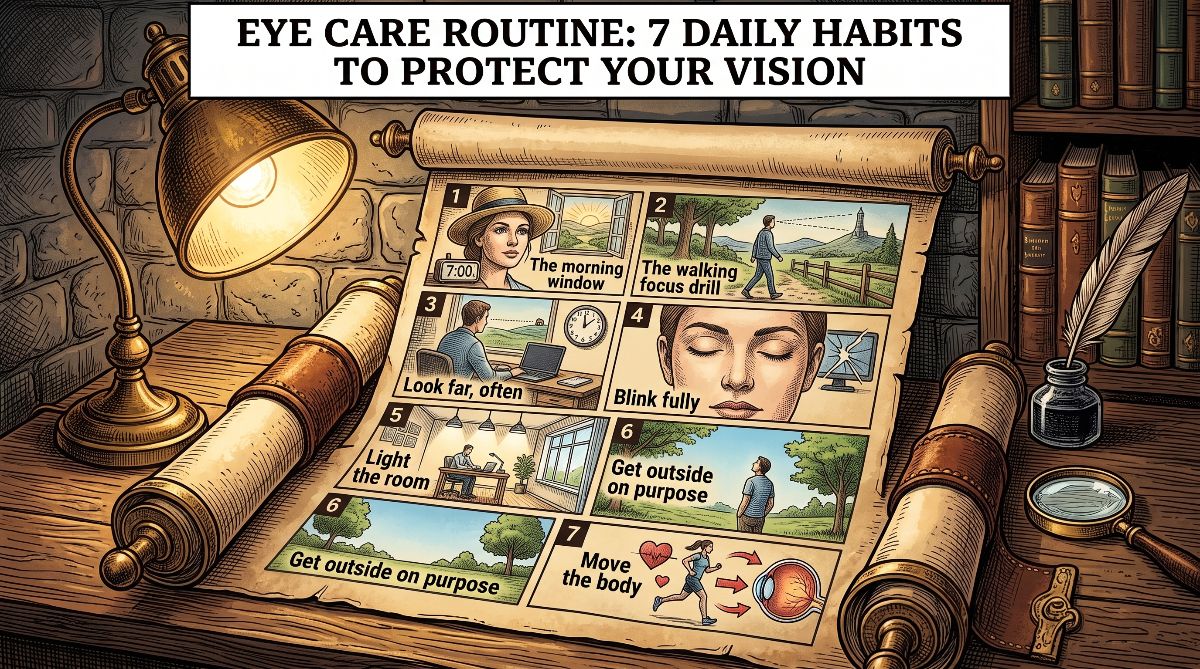
These are the habits worth building into a daily routine. Start with the two that carry the most weight.
- The morning window. When you wake up, open the window and look as far into the distance as you can for two to three minutes. Find the farthest object you can just barely resolve, something a touch blurry, and work to catch it sharp. This does two jobs at once. It hands your eyes distance after a night at arm's length from a pillow, and it feeds you the early daylight that sets your body clock and your focus for the day ahead.
- The walking focus drill. Outside, in open space, find an object in the distance and lock your focus onto it, even if it looks a little blurry. That blur is your starting point. Keep walking, and hold your focus locked on that object as you move, all the way until you pass it, without turning your head. Your eyes carry the target whilst your body carries you. That is focus under motion, the exact opposite of a frozen stare at a screen eighteen inches from your face.
- Look far, often. The focusing muscle only lets go when you look into the distance, and at a desk you almost never do. Every half hour, find the farthest thing in view, or out a window, and rest there for a moment. You are giving the muscle its one chance to release.
- Blink like you mean it. Screens cut your blink rate roughly in half. The tear film breaks up, and vision goes soft and gritty. Blink fully, on purpose, and take proper breaks away from the screen.
- Light the room like you want to see in it. Dim, low-contrast rooms pull your eyes toward a lazy resting point that already sits slightly nearsighted. Work in bright, even light and stop making your eyes fight the room.
- Get outside on purpose, daily. Not through glass. A real walk, a real stretch of open sky, every day. This is the same lever as the daylight above, and it is the one most worth protecting in a calendar.
- Move the body that feeds them. Anything that gets the heart going sends blood to the eye. A daily walk counts. After thirty-five it stops being optional and starts being the quiet difference between an eye that stays fed and one that slowly starves.
The habits that protect the blood behind your eyes
The same bloodstream that carries oxygen to your eye carries everything else you put in your body. Smoking narrows the very vessels that feed it, and it is the clearest villain in all of eye medicine. Food shows up in your eyes because your eyes drink whatever your blood becomes. And sleep matters because the system does its repair work on that cycle. None of this is glamorous. All of it is real.
Supporting your eyes is not the same as retraining them
Everything above protects and supports. It slows the wear and keeps the system fed. But supporting is not the same as retraining. Daylight, movement, clean blood, real food, these keep the ground healthy. They do not, on their own, pull a strained, adapted eye back to sharp. They are the soil. They are not the training.
If your vision has already slipped, the functional layer, the strained muscle and the brain that settled for blur, can often be trained back, not just held in place. That is separate work, done deliberately, and these habits are what make it possible rather than replace it.
How much of your vision is trainable?
Habits keep the system healthy. They cannot tell you how much of your blur is the trainable kind, or whether you are early enough to get most of it back. Only testing can.
That is what the evaluation is built to answer. Your eyes go through the work, and you watch what comes back. How much can your vision improve in your case? Book the free evaluation and find out.
How much can
your vision improve?
Book free evaluation
91.6% of clients read at least one more line on the chart by the end of this call.
- Rose, K. A., Morgan, I. G., Smith, W., Burlutsky, G., Mitchell, P., & Saw, S. M. (2008). Myopia, lifestyle, and schooling in students of Chinese ethnicity in Singapore and Sydney. Archives of Ophthalmology, 126(4), 527–530. https://pubmed.ncbi.nlm.nih.gov/18413523/ ↩
- Dirani, M., Tong, L., Gazzard, G., et al. (2009). Outdoor activity and myopia in Singapore teenage children. British Journal of Ophthalmology, 93(8), 997–1000. https://pubmed.ncbi.nlm.nih.gov/19211608/ ↩
- Torii, H., Kurihara, T., Seko, Y., et al. (2017). Violet light exposure can be a preventive strategy against myopia progression. EBioMedicine, 15, 210–219. https://www.thelancet.com/action/showPdf?pii=S2352396416305862 ↩
- Lovasik, J. V., Kergoat, H., Riva, C. E., Petrig, B. L., & Geiser, M. (2004). Consequences of an increase in the ocular perfusion pressure on the pulsatile ocular blood flow. Optometry and Vision Science, 81(9), 692–698. https://pubmed.ncbi.nlm.nih.gov/15365389/ ↩
- Johnson, S., & Rosenfield, M. (2023). 20-20-20 Rule: Are These Numbers Justified? Optometry and Vision Science, 100(1), 52–56. https://onlinelibrary.wiley.com/doi/10.1097/OPX.0000000000001971 ↩