Dark theme feels easy on the eyes. Dim, low glare, sleek. For casual scrolling, it mostly is. But if your eyes already run a little soft, or you live in glasses or contacts, that comfort can be a trap. Used all day, every day, a dark screen can walk your focus in the wrong direction without you noticing.
Your eyes run on light
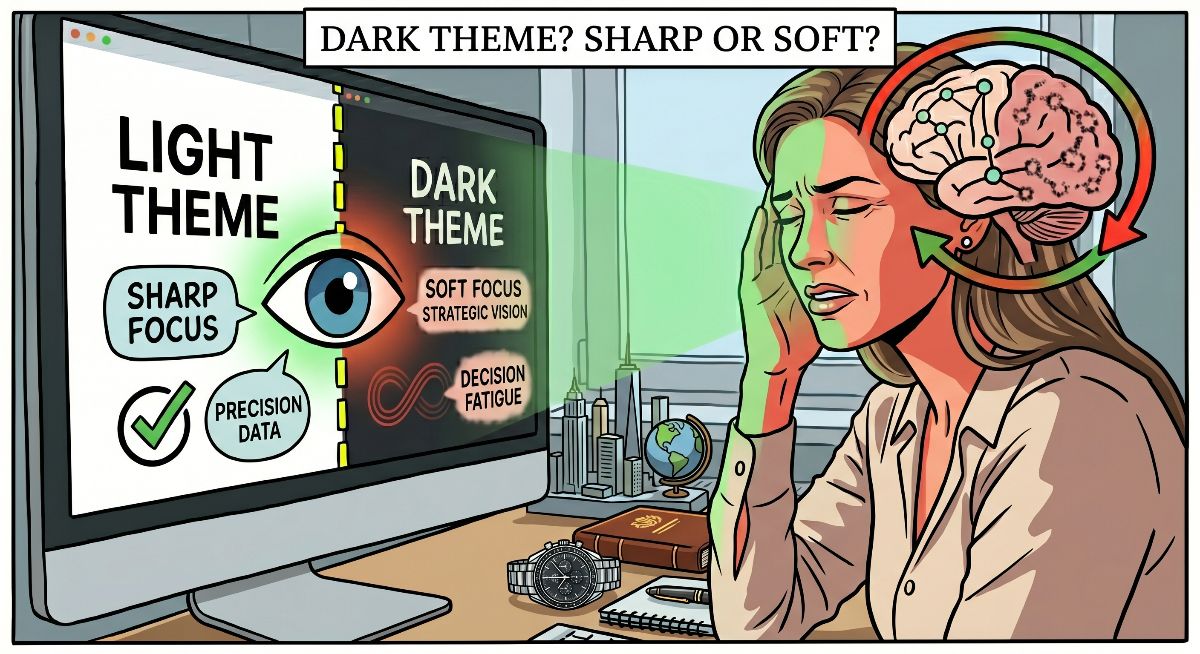
A bright background does something specific. It shrinks your pupil, and a smaller pupil is a sharper lens. It's called the positive polarity advantage.
Piepenbrock and colleagues measured it in 2014[1]: people read faster and caught finer detail on dark text over a bright background, with smaller pupils.
Dark theme flips that. Less light, wider pupil, softer image. You will not catch it on a quick glance. You catch it after days and hours of real focus, when the edges start to swim.
In the dark, the eye drifts closer
Low light pulls a hidden lever. With too little contrast to lock onto, the eye relaxes toward a lazy resting point that sits slightly nearsighted. Leibowitz and Owens[2] mapped this "dark focus" decades ago and placed it near one and a half diopters of myopia. Your focus starts hunting in and out, the way a camera breathes when it cannot find the shot.
Do that long enough and the brain adapts. It resets what normal looks like. Webster's research in 2002[3]showed that
That is the loop. Soft picture, lazy focus, brain calls it normal, focus drifts softer still. And the eye that lived in the dark now sits with its pupil open more of the day and its focus parked a notch short of sharp.
The pre-condition no one warns you about
Past comfort, this is where it reaches your eyeball. A chronically blurred image is a known trigger for the eye to grow longer, which is nearsightedness itself. Smith and colleagues proved it cleanly in animals in 2000[4]: more blur, more growth, in lockstep. Modern indoor life, all screens and soft contrast, may feed that same signal.
However, dark themes will not hand you a prescription overnight. But it builds the soil that myopia grows in for those who work 80% staring at screens days away. Early, quiet, and for most people, still reversible.
Why light theme is the better one
Light theme can feel more tiring at first - and that is the point. Tired eyes mean your eyes are working and focusing the way they should, and that fatigue is honest feedback telling you to rest. Dark theme hides it behind that soft, about-focus comfort. Less felt strain today, more drift down the road. It goes easy on you now and bills you later.
I have lived this myself
Through a long stretch of intense work, every screen I touched ran a dark theme, and my focus drifted exactly the way. Turning it around was part of my own vision work. I moved everything to bright themes, and the same mechanism ran in reverse. Little by little, my eyes started to favor the sharp edge again, but the brain was resisting a lot. So, I had to support the improvement with my method and fully recovered shortly. Now, I'm mixing light and dark themes. Further in the article I explain how I do it.
How much can
your vision improve?
Book free evaluation
91.6% of clients read at least one more line on the chart by the end of this call.
Light theme has its own bill, too
Dark theme is not the only one with a cost. The same hard contrast that sharpens your focus, black text on a bright field, drives only one half of your retina. Your eye runs two channels: one fires for bright marks on a dark ground, the other for dark marks on a bright ground. Read black-on-white for hours and you are flooring the second channel and starving the first.
And that lopsided load may cost you. Aleman and colleagues found in 2018[5] that one hour of reading black text on a bright screen thinned the choroid, the nourishing layer behind the retina, while reading white-on-black thickened it. A thinner choroid is one of the early signals of an eye starting to grow too long, the road to myopia. It is a small, early study, not a verdict. But it lands on the same place from the other side: live in pure light theme and you are leaning on your eyes just as hard, only through a different door.
My fix: run it ~70/30
Living in one mode only is like living only by day or only at night. Lock your eyes into a single setting and they lose their range. So do not pick a side. My rule runs about 70/30:
- Light theme when you need sharp focus and concentration. Most of your screen time. Call it 70%.
- Dark theme for the rest. Low stakes, low light, winding down. The other 30%.
- And the one thing no setting can replace: real daylight, outdoors, every single day. The strongest protection your eyes have.
Why natural light is the real medicine
No screen, bright or dark, can stand in for the sun. Daylight is not just another light source. It does things for your eyes a display physically cannot:
- It releases dopamine. Bright outdoor light triggers dopamine in the retina, thought to act as a brake on the eye growing too long. Rose and colleagues found in 2008[6] that children who spent more time outdoors were far less likely to become nearsighted.
- It builds vitamin D. Sunlight on skin is how your body makes vitamin D, which supports your eyes and nearly everything else.
- It sets your clock. Strong daytime light anchors the daily rhythm your eyes run on, the same cycle that governs eye growth and sleep.
- It rests your focus. Outdoors, your gaze travels far and the near-focusing muscles finally stand down.
- It is simply brighter. A bright day can be hundreds of times more intense than a lit room, and that intensity is the active ingredient your eyes are hungry for.
Your eyes adapt to whatever world you build for them. That is the warning, and the way out. If your focus has gone soft, it is not stuck there. It can be trained back.
How much can
your vision improve?
Book free evaluation
91.6% of clients read at least one more line on the chart by the end of this call.
- Piepenbrock, C., Mayr, S., & Buchner, A. (2014). Smaller pupil size and better proofreading performance with positive than with negative polarity displays. Ergonomics, 57(11), 1670–1677. https://www.tandfonline.com/doi/abs/10.1080/00140139.2014.948496 ↩
- Leibowitz, H. W., & Owens, D. A. (1975). Anomalous myopias and the intermediate dark focus of accommodation. Science, 189(4203), 646–648. https://www.science.org/doi/10.1126/science.1162349 ↩
- Webster, M. A., Georgeson, M. A., & Webster, S. M. (2002). Neural adjustments to image blur. Nature Neuroscience, 5(9), 839–840. https://www.nature.com/articles/nn906 ↩
- Smith, E. L., III, & Hung, L. F. (2000). Form-deprivation myopia in monkeys is a graded phenomenon. Vision Research, 40(4), 371–381. https://www.sciencedirect.com/science/article/pii/S0042698999001844?via%3Dihub ↩
- Aleman, A. C., Wang, M., & Schaeffel, F. (2018). Reading and myopia: Contrast polarity matters. Scientific Reports, 8, 10840. https://www.nature.com/articles/s41598-018-28904-x ↩
- Rose, K. A., Morgan, I. G., Ip, J., et al. (2008). Outdoor activity reduces the prevalence of myopia in children. Ophthalmology, 115(8), 1279–1285. https://www.aaojournal.org/article/S0161-6420(07)01364-4/abstract ↩