You have a number. Minus one. Minus three. Minus six. Somebody wrote it on a card years ago and you have carried it around ever since like a fact about yourself.
Here is what nobody told you. That number is not one thing. It is a sum. And nobody has ever broken it down for you.
Two things in the box
Some of your blur is the shape of your eye. The curve of your cornea. How far back your retina sits. Physical, built over years, and mostly settled by the time you were twenty-five. That part stays. The rest is habit. A focusing muscle that never fully lets go. A brain that quietly stopped reaching for the sharp edge. That part is trainable.
The number your prescription never measured
This is the part that changes everything, so read it twice.
Your prescription measures the shape of your eye. The chart measures what you can see. Everyone assumes those are the same number. They are not.
Yan and his colleagues [1] took nearsighted adults and trained them for ten days. No lenses, no surgery, no drops. At the end, they read further down the chart with their bare eyes. Better contrast sensitivity. Better acuity. And in the eye they never trained, the gains showed up anyway.
Then they measured refraction. It had not moved.
The shape of the eye did not change. Not by a hair. The chart changed. Which means the improvement did not happen in the eyeball at all. It happened behind it.
Your brain gave up on sharp. It can be talked back.
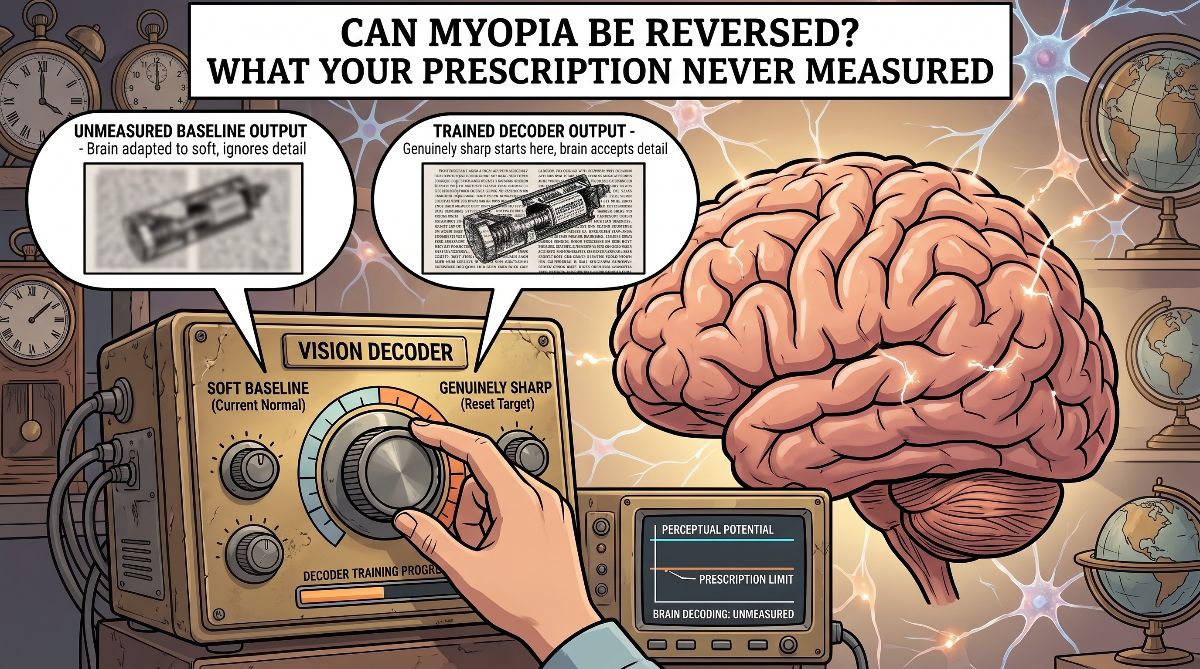
Live in soft images long enough and your brain resets what normal looks like. Webster and his team [2] showed it: after a stretch of blur, a genuinely sharp image starts to look wrong. Too sharp. So the brain stops asking for it.
That runs both ways. A baseline that drifted soft can drift back. Nothing about your eye has to change for you to see more of what is already landing on your retina.
Most people have spent a decade with a decoder nobody bothered to train.
How much can
your vision improve?
Book free evaluation
91.6% of clients read at least one more line on the chart by the end of this call.
Taking your glasses off is not the plan
Let me kill an idea before it costs you two years.
Blur left alone is not medicine. Chung and his colleagues [3] put nearsighted children in deliberately weak glasses and tracked them for two years against children who were fully corrected. The undercorrected group got worse. Faster. In prescription and in the length of the eye.
Read that again. Sitting in blur and waiting made things worse, not better.
Blur is a signal. On its own, it is a growth signal. It only becomes useful when the brain is actively trained to resolve it. That is the whole difference between hoping and training, and it is the difference between a plan and a shrug.
The lenses come off at the end. Because your eyes earned it. Not on day one because somebody told you optics are the enemy.
The audit that never happened
There is exactly one way to see your split.
An optometrist puts in drops that switch the focusing muscle off. Then measures again. Whatever is left is the shape of your eye. Everything that disappeared was muscle. They call it a cycloplegic refraction, and it takes twenty minutes.
Almost no adult has ever had one. The standard exam measures straight through a half-clenched muscle and writes down one number for both.
So you have been carrying a figure that nobody audited. You built a story about your eyes on top of it. And you never once saw the breakdown.
How far this goes
I will not pretend to know your ceiling.
Where the eye never changed shape, people end up reading 20/20 with nothing on their face. Where it did, that part stays and you gain the rest. The trainable share is bigger at low prescriptions, for the simple reason that a small number has less shape in it to begin with.
And if the shape did change, you are not stuck either. Laser surgery does not shorten your eyeball. It reshapes the cornea so the light lands right on a retina that is still sitting too far back. Nobody calls that a trick. Training does the same job from the other end, with the muscle and the brain instead of a laser.
So which one are you?
Two people walk out of the same exam holding the same card. One of them has almost nothing to work with. The other has been sitting on years of recoverable vision and has no idea.
You will not find out by reading. You find out by testing.
That is what the evaluation is for. Your eyes go through the work and you watch the chart. If you read further down before the session ends, that line did not come from your cornea and it did not come from the length of your eye. It came from the part that was trainable the whole time.
And if nothing moves, you will know that too. Honestly, and for the first time.
I cannot tell you where your ceiling is. What I can tell you is that almost nobody has met theirs.
How much can
your vision improve?
Book free evaluation
91.6% of clients read at least one more line on the chart by the end of this call.
- Yan, F.-F., Zhou, J., Zhao, W., Li, M., Xi, J., Lu, Z.-L., & Huang, C.-B. (2015). Perceptual learning improves neural processing in myopic vision. Journal of Vision, 15(10), 12. https://jov.arvojournals.org/article.aspx?articleid=2464641 ↩
- Webster, M. A., Georgeson, M. A., & Webster, S. M. (2002). Neural adjustments to image blur. Nature Neuroscience, 5(9), 839–840. https://www.nature.com/articles/nn906 ↩
- Chung, K., Mohidin, N., & O'Leary, D. J. (2002). Undercorrection of myopia enhances rather than inhibits myopia progression. Vision Research, 42(22), 2555–2559. https://www.sciencedirect.com/science/article/pii/S0042698902002584 ↩